
Half the time, how to identify a bug is not an identification problem at all. It is a photography problem. The insect is a tenth of an inch (2 or 3 mm) long, the phone will not focus that close, and the resulting picture is a gray smudge that no person and no software can do anything with.
Iowa State’s Plant and Insect Diagnostic Clinic, which reads these photographs for a living, asks for four things: get as close as the camera allows, work in a brightly lit room or outdoors, use a plain gray or white background, and put a size reference in the frame such as a coin or a ruler.
Everything below is what those four instructions mean when the subject is smaller than a grain of rice, starting with the one that trips people up, which is that as close as the camera allows is not as close as your arm can reach.
What does the photograph actually have to show?
It depends on the group, and knowing which feature matters saves you from taking twenty pictures of the wrong angle.
For ants, the features are the waist and the profile of the back. Texas A&M’s household ant guide separates species partly on whether the pedicel between thorax and abdomen carries one node or two, and partly on whether the thorax is smoothly curved in profile or carries spines. Both are side-on features, so a photograph taken from directly above an ant is almost useless.
For beetles, the useful features are the top. The seam where the hardened wing covers meet down the middle of the back, whether those covers are grooved or smooth, and whether the head is narrower than the plate behind it are all visible from above.
For small moths, it is the folded wing. The pattern that separates one pantry moth from another is a band across the forewing, and it only reads when the wings are folded flat over the body rather than spread.
For the very small beetles, it is the antennae, and this is where the limits bite. NC State separates red from confused flour beetles on whether the antennae end in a three-segmented club or no apparent club at all, and cigarette from drugstore beetles on whether the antennae are serrated or end in three much larger segments. Those are real features. They are not features a phone camera will resolve on a beetle of 1/8 inch (3 mm) at arm’s length, and no amount of technique changes that.
Why will the phone not focus on it?
Because every lens has a minimum focus distance, and on most phones the main camera will not hold focus once you push it right up against a subject. Inside that distance the image goes soft no matter how many times you tap the screen. The instinct when a subject is small is to keep moving closer, and past that point it stops helping.
So get as close as the camera will still focus, and no closer. Back off until the image snaps in, take the picture at full resolution, and crop afterward. A sharp crop of a small subject beats a full-frame blur every time, which is why Iowa State asks for as high a resolution a photo as you can send, so the clinic can zoom in.
Two other things help more than people expect. Iowa State notes that tapping the screen will often set the focus automatically on a phone. That matters because a phone left to itself will usually focus on the surface behind a very small subject rather than on the subject. And Iowa State’s advice to take several pictures but send only the best one or two is the right workflow: at this scale most frames are misses, and you cannot tell which is which on a phone screen.
The four things that belong in the frame
A plain light surface. Iowa State says a plain gray or white background is usually best. An index card, a sheet of paper or a white plate removes the pattern that a countertop or a carpet puts behind a subject this small, and it gives the camera something to meter against.
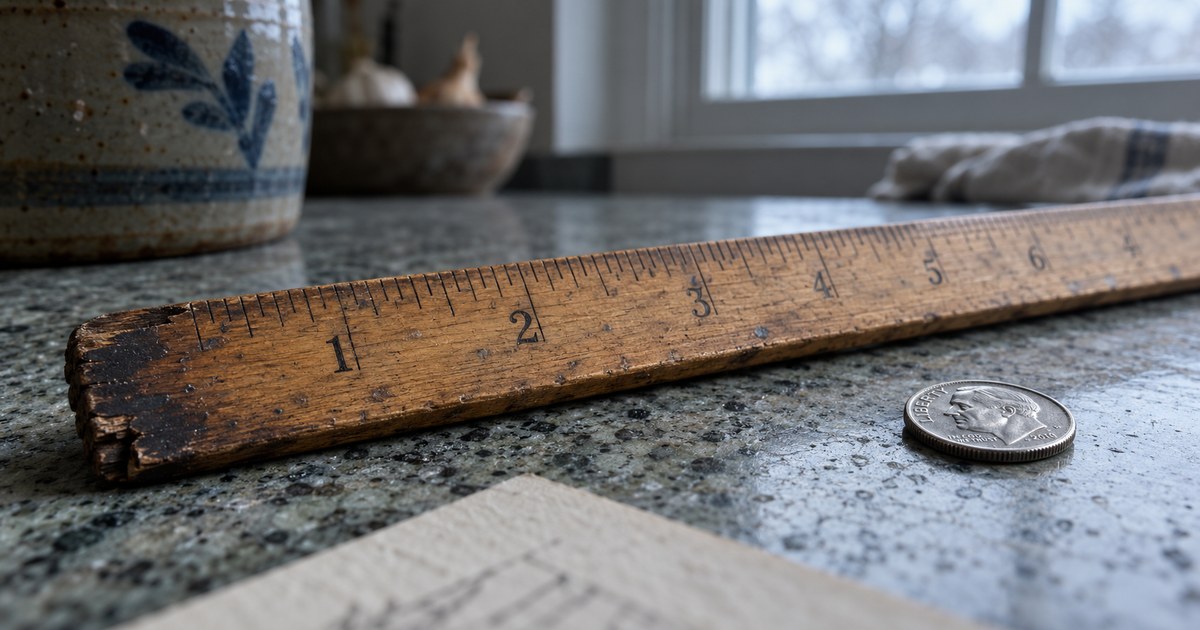
A scale object. It is the item most often missing from the photographs that reach a diagnostic clinic, and it is the one that does the most work. Iowa State asks for a size reference such as a coin, a pencil, a ruler or a yardstick, depending on size. A dime beside a beetle turns an unknown object into a measured one, and in this subject most of the questions are settled by size. Without it, a reader’s memory inflates the insect and a photograph gives no way to correct that.
Light, from the side you are standing on. A brightly lit room, next to a window, or outdoors. Backlighting turns a small dark insect into a silhouette, which loses the color and the surface texture that carry the identification.
Two views if you can get them. Iowa State asks for a picture of the top and of the bottom of the insect if possible. For a household reader the realistic pair is top and side, taken without moving the insect: step around it rather than turning it over.
The order that wastes the fewest frames is this. One wide shot from directly above with the scale object in it, taken first because it is the one you are most likely to get before the insect moves. Then a closer frame from above at the minimum focus distance. Then the side view, for the waist and the back profile. Then, only if the insect is still there, a fourth at a different angle to the light, because a shiny insect photographed from one angle alone often loses its markings to glare.
Photograph the insect where it sits. If it is already on a hard floor or a windowsill, that is a usable surface. If it needs to be somewhere plainer, coax it onto a sheet of paper rather than moving it by hand, and shoot it there.
Sort before you shoot
Most of the time you are choosing between two or three candidates, not identifying something from nothing, and it is worth knowing which two before you spend the frames. The roach lookalike walkthrough sets out the one test that separates a beetle from a cockroach, and the indoor ants walkthrough gives the three features that sort ants. For the tiny white specks on a houseplant, tiny white bugs on plants gives the one test that sorts a mealybug from a whitefly. Both tell you what to point the camera at.
Record the other three things while you are there, because they are free and they are often what actually settles the question. Iowa State’s submission guidance asks for the county and state, the date, and the insect’s size and location, plus where you are seeing them, inside or outside or on a plant, and how many. Room, season, size and count narrow a list further than a mediocre photograph does.
When no photograph will ever be good enough
Sometimes the honest answer is that the picture cannot carry the identification, and the agencies that do this professionally say so plainly.
Iowa State’s clinic states that it cannot guarantee identifications from photos and recommends sending a sample for the most accurate identification, especially for small insects that are challenging to get in focus, and notes that it may ask you to send the specimen in when a photo proves insufficient. Texas A&M’s ant guidance points the same way: collect a few to examine under a hand lens, magnifier or microscope if you have one, and check with your county extension agent for assistance.
That is the route when the answer has to be exact, and it is not a failure of the photograph. Many insects are separated on features that only exist under magnification, and no software and no photograph gets around that.
What a good photograph does do is get you from nothing to a shortlist of two or three, which is the step that actually changes what happens next in a house. That is the step worth optimizing for.
Once the frame is usable, Bug Identifier reads that one photograph and returns the common name, the other names it goes by, the scientific name and classification, a description to check the match against, and the role, meaning beneficial, harmless or a pest and to what. Scans are kept by date, which turns a year of one-off questions into a record of what actually lives around a particular house. What it reads is a photograph of an insect, which is worth saying plainly on a page about photographs: not a photograph of skin, not a sound, and not a building.
To start from the room and the description rather than from a name, go to what bug is this, or browse all the guides.
Sources
- Insect/Arthropod Photo Submission Instructions, Iowa State University Plant and Insect Diagnostic Clinic
- Submitting an insect, spider, mite, or other arthropods for identification, Iowa State University Plant and Insect Diagnostic Clinic
- Identifying household ants, Insects in the City, Texas A&M AgriLife Extension
- Common Pantry Pests and their Management, NC State Extension Publications