
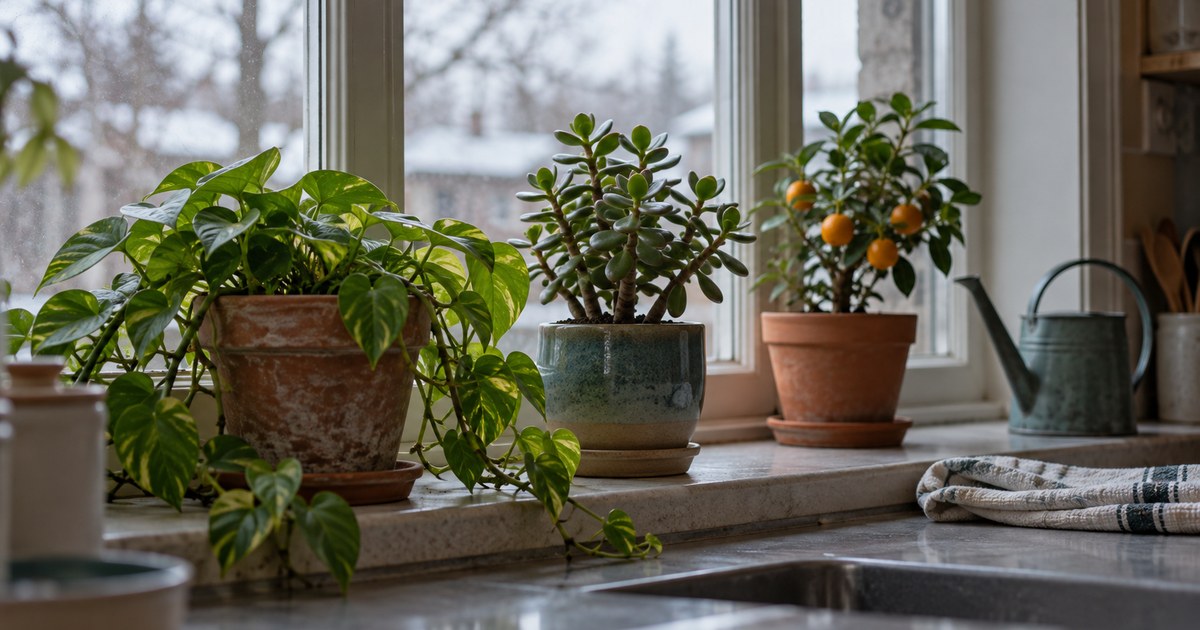
The plants came indoors for the winter, and now there is something small and white on them. It might be a fluff of cotton in the crook of a stem, a few specks that lift off when a leaf is brushed, or a smudge of white on the underside of a new leaf. Those three descriptions belong to three different insects, and one quick test separates most of them.
Tiny white bugs on plants are commonly mealybugs, whiteflies or one of the few aphids that coat themselves in white wax. Whiteflies flutter away when the plant is disturbed, according to the University of Kentucky, and are 1/16 to 1/10 inch (1.6 to 2.5 mm) long. Mealybugs sit under cottony wax and stay in place.
Does it fly up when the leaf moves?
Start here, because the answer comes in a second and does not need a lens. Brush the foliage or turn the pot. Kentucky’s whitefly fact sheet notes that adult whiteflies will flutter away from plants if disturbed and suggests disturbing the canopy precisely to reveal them. A small cloud of white specks rising off the leaves and settling again is whiteflies.
If nothing lifts off, the white thing is stationary or close to it. Mealybugs, the nymphs of whiteflies, and the waxy aphids all stay where they are for long enough to look at. That leaves the shape and the wax to sort them.
It flies: whiteflies
Kentucky gives adult whiteflies as very small, 1/16 to 1/10 inch (1.6 to 2.5 mm), with powdery white wings. The fact sheet separates the two common greenhouse species by how the wings are held at rest. The greenhouse whitefly holds its wings flat, which gives it a triangular look from above; the sweetpotato whitefly holds them at a sharp tent-like angle, so from above it looks narrow, like a grain of rice. Separating them reliably is a job for magnification, and for most households the useful answer is simply whitefly.
Look under the leaves for the rest of the population. Kentucky notes that eggs are laid on the undersides of leaves and the whole life cycle happens there, with adults, eggs and young nymphs usually on fresh, newly expanded leaves and older nymphs and cast skins on more mature foliage. The nymphs do not look like flies at all. Kentucky describes greenhouse whitefly nymphs as shaped like a pillbox, with flat vertical sides and long waxy filaments on top, while sweetpotato whitefly nymphs lie flatter against the leaf with only a few delicate filaments.
It sits under cotton: mealybugs
This is the one most people mean when they say white fuzzy bugs. Washington State University describes mealybugs as named for the white, powdery or cottony wax covering their grayish to pinkish bodies, slender, flattened and soft-bodied, and says the cottony material is often the earliest sign anyone notices.
The size figures differ, and the difference is worth stating. Washington State gives mealybugs as usually about 3/16 inch (4.8 mm) long. The University of Wisconsin-Madison Division of Extension gives adult females as about 1/16 inch (1.6 mm) long. The two agencies are not necessarily describing the same species, and mealybugs are a large group, so treat anything in roughly that span with a cottony coat as a candidate.
Where they sit is part of the identification. Wisconsin notes that they commonly gather at growing tips and new growth, that the citrus mealybug is most often seen on foliage, and that the longtailed mealybug often hides in leaf whorls. It also describes egg masses: female citrus mealybugs lay eggs within a protective mass of white, cottony threads, up to 600 tiny yellow eggs per female. A white tuft with no obvious insect in it may be one of those.
Some mealybugs live underground. Wisconsin describes the ground mealybug, which lives on the roots of many houseplants, especially African violets, and notes that small white cottony masses around the drainage holes of a pot can signal it. Confirming it usually means taking the root ball out of the pot, which is a reasonable thing to leave to your local extension service if the plant matters to you.
It is soft, pear-shaped and not very white: aphids
Most aphids are not white at all. UC IPM describes aphids as small, soft-bodied insects with pear-shaped bodies and long legs and antennae, colored green, yellow, brown, red or black depending on the species and the plant. A few species, UC IPM notes, appear waxy or woolly because they secrete a white or gray waxy substance over the body surface, and those are the ones that turn up in a white-bug search.
The feature that settles an aphid is at the back end. UC IPM describes a pair of tubelike structures called cornicles projecting backward from the hind end of most species, and says their presence distinguishes aphids from all other insects. On a waxy aphid the wax can hide them, which is one of the cases where a close photograph does better than the eye.
UC IPM also notes that aphids are generally wingless as adults, but that most species also occur in winged forms, more commonly when populations are high or in spring and fall. A winged aphid flying up from a plant can be mistaken for a whitefly, which is why the body shape and the cornicles are worth checking on anything that lands again.
The white thing that is eating the mealybugs
Before deciding anything about a plant with white bugs on it, check whether one of them is much bigger and moving faster than the others. UC IPM’s natural enemies gallery describes the larva of the mealybug destroyer, a lady beetle, as closely resembling a mealybug. It grows up to 1/2 inch (12 mm) long, which UC IPM puts at more than twice the size of an adult female mealybug, and it is faster moving.
UC IPM gives the features that separate them. The larva has long wax filaments protruding from the top and sides, where a mealybug has only short filaments along the sides and, in some species, two to four longer ones at the rear. The larva also has distinct legs and mouthparts, which are hard to see on a mealybug. It feeds on mealybug eggs and young nymphs and, as it grows, on mealybugs of any age.
The adult is a small lady beetle, 1/8 to 1/6 inch (3 to 4 mm) long according to UC IPM, with a blackish abdomen and a dark brown to orange head and thorax. The same pattern of a larva that looks nothing like the adult runs through the whole family, and the ladybug larvae post covers the more common ones.
What if the white specks are in the soil?
Then they are probably not any of the above. Tiny pale insects that jump on damp potting soil may well be springtails, which the tiny black bugs walkthrough covers in its section on things that jump in damp rooms. Small dark flies drifting up from the soil surface are often fungus gnats, and the fungus gnat and fruit fly guide separates those two.
Which of these will a photograph not settle?
A clear photograph usually separates a whitefly from a mealybug from a waxy aphid, and it will usually tell a mealybug destroyer larva from a mealybug by size and filament length. It will not reliably separate whitefly species, mealybug species or aphid species, all of which turn on features that need magnification. For an exact answer, a county extension office can examine a sample.
For a usable frame, turn the leaf over and photograph the underside where it is, with a coin or a ruler edge beside it for scale, and back the phone off a little rather than pushing closer. The guide to photographing a tiny insect goes through the rest. Once you have narrowed it to two or three, Bug Identifier reads a single photo and returns the common name, its other names, the scientific name and classification, a description to check the match against, and its role, which is the field that tells a mealybug from the beetle larva eating it. Scans stay in a dated collection, so the plant’s history over a winter sits in one place.
To start from somewhere other than a houseplant, go to what bug is this.
Sources
- Mealybugs, Pestsense, Washington State University
- Mealybugs, Wisconsin Horticulture, University of Wisconsin-Madison Division of Extension
- ENTFACT-456: Whiteflies in the Greenhouse, University of Kentucky Entomology
- Aphids, Pest Notes, UC Statewide IPM Program
- Mealybug Destroyer, Natural Enemies Gallery, UC Statewide IPM Program