
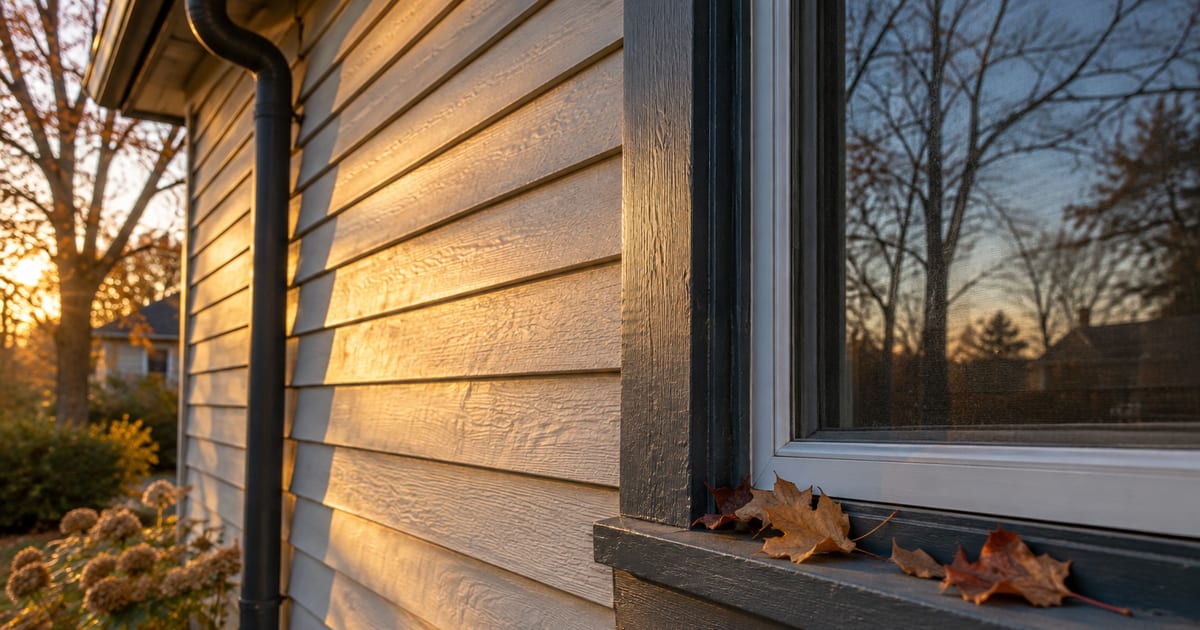
From September through November, the insects showing up on a windowsill are mostly not tiny. Five of them move to sunlit walls at this time of year looking for somewhere to spend the winter: the multicolored Asian lady beetle, the boxelder bug, the brown marmorated stink bug, the western conifer seed bug and the cluster fly. Size sorts them quickly.
They arrive together because they are all doing the same thing for the same reason. Knowing which one you have changes what to expect in January, and it is the difference between an insect that will stain a curtain and one that will not.
Why do they all turn up in the same three weeks?
Because the trigger is temperature, not the calendar. The University of Kentucky’s fact sheet on Asian lady beetles describes adults leaving their summer feeding sites in yards, fields and forests as autumn approaches, and says swarms typically fly to buildings from September through November depending on locale and weather, with most migration to buildings in Kentucky happening in October. It adds the detail that makes the timing predictable: flights are heaviest on sunny days that follow a spell of cooler weather, when temperatures come back up to at least the mid-60s Fahrenheit, and most of that flight activity happens in the afternoon.
The others run on the same clock. Penn State puts brown marmorated stink bug adults searching for overwintering sites from September through October. It has western conifer seed bug adults feeding on ripening seeds until early fall and then seeking sheltered places, and notes they congregate on the outside of buildings in late summer and early fall in northeastern North America. Cluster flies, in Penn State’s account, look for protected overwintering sites with the onset of autumn, in hedge rows, under bark, in crevices of south-facing cliffs and rock faces, and in the cracks and voids of sheds, garages and houses.
Why this wall and not the neighbor’s?
Sun and contrast. Kentucky reports that Asian lady beetles are attracted to illuminated surfaces and tend to congregate on the sunnier, southwest sides of buildings lit by the afternoon sun, while homes shaded from that light are less likely to attract them. More surprising is what does not matter: house color and construction type count for less than surface contrast. Dark shutters on light siding, light trim around a window, a downspout against a contrasting wall, all of it draws them. Homes near woods or fields are especially prone.
Boxelder bugs behave the same way for the same reason. Kentucky notes they are often seen on the south side of trees, buildings and other structures, warming themselves in the sun.
Which of the five is it?
Measure first. These five are separated by size before anything else, and four of them are between a quarter and three quarters of an inch.
Multicolored Asian lady beetle, about 1/4 inch (6 mm). Kentucky describes the adults as oval and convex, varying widely from tan to orange to red, often with black spots on the wing covers that may be indistinct or missing altogether. Color settles nothing here. The mark that does is on the whitish area behind the head, where most beetles carry a small dark M or W shape. Once indoors they crawl about on windows, walls and in attics, and Kentucky notes they secrete a foul smelling yellowish fluid from their leg joints when disturbed. The Asian lady beetle and ladybug comparison works through the rest. The young look nothing like the adults, and ladybug larvae get a guide of their own.
Boxelder bug, up to half an inch (13 mm). Kentucky gives the adult a black body with red lines running down the center and sides of the pronotum, the plate over the thorax, and notes that nymphs are bright red and that both nymphs and adults have dark red eyes. It is most often confused with the milkweed bug, the same size and the same colors in a different arrangement: boxelder bugs are mostly black with thin red stripes, while milkweed bugs are mostly orangish red broken by large patches or belt-like stripes of black. Kentucky states plainly that boxelder bugs do not bite or sting people or animals and that there is no evidence they transmit disease, but also that their fecal matter may stain fabrics and surfaces and that they give off a pungent odor when crushed. Because females depend on fruit-producing boxelder trees to lay eggs, Kentucky notes they cannot establish a long-term population indoors. See the boxelder bug guide.
Brown marmorated stink bug, approximately 17 mm (0.66 inch). Penn State describes it as shield shaped and almost as wide as it is long, in shades of brown above and below. To tell it from the native stink bugs, Penn State says to look for the lighter bands on the antennae and the darker bands on the membranous overlapping part at the rear of the front wings, plus patches of coppery or bluish metallic punctures on the head and pronotum. It will not reproduce inside a building or damage it. Penn State does record that the defensive chemicals can act as an aeroallergen and produce allergic reactions in people sensitive to the odor. More detail is in the stink bug guide.
Western conifer seed bug, 3/4 inch (19 mm). The biggest of the five and the one people find most alarming. Penn State gives it as reddish brown to dark brown, with the membranous halves of the forewings dark brown and forming a diamond at the rear, often with a thin jagged white line along the back. Along the edge of the wings the upper side of the abdomen shows alternating patches of yellow to light orange and black. Flying adults produce a loud buzz which, together with that bright abdomen, may mimic a bee. Penn State notes it is not considered a medical risk and that a single bite has been recorded worldwide. It feeds on the seeds of pines, spruces, hemlocks and Douglas fir, so a conifer in the yard is the usual explanation. The western conifer seed bug guide shows how to tell it from a stink bug by its flattened hind legs.
Cluster fly, slightly larger than a house fly. Penn State compares it directly to the common house fly and calls it dull gray with black markings, with golden yellow hairs on the thorax that can give the appearance of a golden sheen. The larvae develop in earthworms in the soil, which is why these flies are not breeding in the walls even when hundreds of them appear there. Penn State notes they are typically sluggish in flight, may leave small dark spots of excrement on windows and walls, and are not known to carry diseases of medical importance to humans.
What if the thing on the sill really is tiny?
Then it is not one of these. None of the fall arrivals is smaller than about a quarter inch, so a speck of 1 to 3 mm belongs to a completely different cast: carpet beetle adults, pantry beetles, fungus gnats, springtails and booklice. Those are sorted in tiny black bugs in the house. One seasonal note worth keeping straight: Kentucky records carpet beetle adults appearing on windowsills in springtime, not fall, so a small mottled oval beetle on the sill in April is telling you something different than a stink bug on the sill in October.
What happens after they get in?
They go quiet, then they reappear at the window. Penn State describes cluster flies becoming active on warm days and crawling out of wall voids and attics in a confused attempt to get back outside, gathering in large numbers at windows on warm winter days. Kentucky has Asian lady beetles seeking out crevices once they land on a building and congregating in attics and wall cavities.
So the ones you see in January are the same individuals, not a second generation, and they are trying to leave. Four of these five do nothing to a house at all, which is why the name is worth having.
If it is on the outside of the glass, photograph it through the window and let the picture do the work. Bug Identifier names an insect from one photo and returns its common name, its other names, the scientific name and classification, a description of the appearance to check against what you are looking at, and its role, meaning whether it is beneficial, harmless or a pest and to what. The collection keeps every scan with its date, which is how a windowsill in October becomes a record of what visits one house each year.
Penn State’s own guidance for all of these is mechanical rather than chemical, which is to say sealing the gaps before the insects find them. This site gives no treatment advice: for that, your local university extension service or a licensed professional is the right place to ask, and any reaction to a sting or a bite is a question for a doctor or poison control. To work from the room instead of the insect, start at what bug is this, or browse all the guides.