
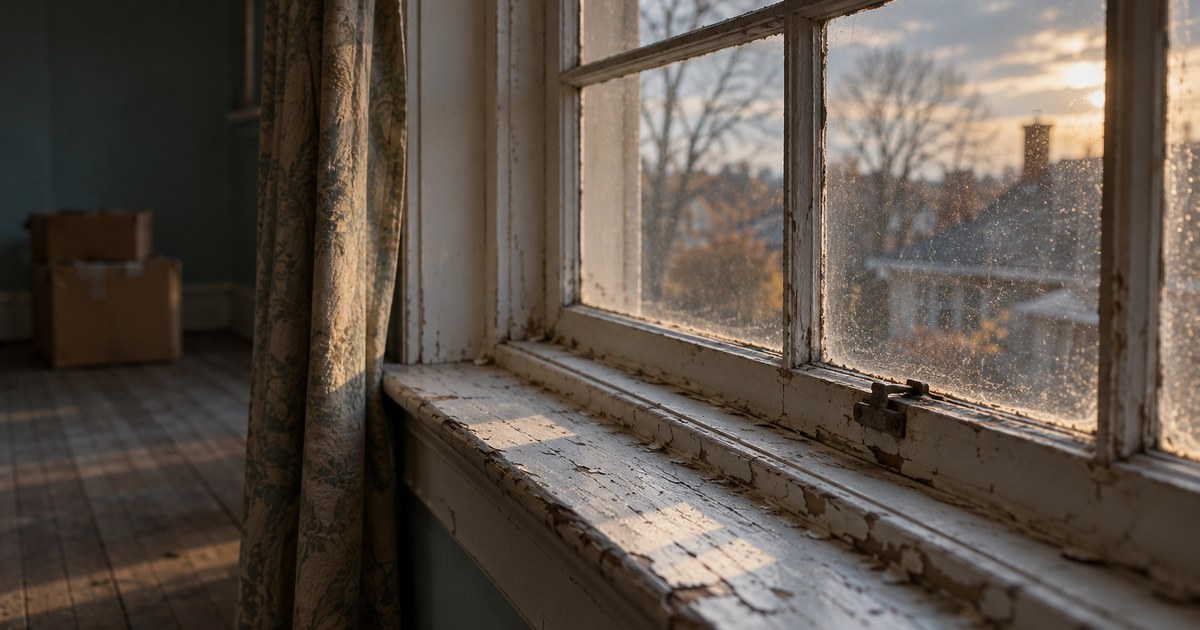
A dozen slow, dull gray flies on the inside of an upstairs window in October, in a room nobody uses, is one of the most predictable insect events of the year. They are almost certainly cluster flies, and the thing that makes them recognizable is not a marking. It is the pace.
Cluster flies are slightly larger than a house fly, dull gray and non-metallic, with short golden hairs on the thorax. They move sluggishly and gather at windows in rooms that stay closed. The larvae develop inside earthworms in the soil outside, so nothing is breeding in the building.
How do you tell a cluster fly from a house fly?
Speed first, then color. Penn State describes cluster flies as typically sluggish in flight, and Montana State puts it the same way, slow moving compared with a house fly. A house fly in a warm room is difficult to get near. A cluster fly on a windowpane in October will often let you get close enough to look at it, and that alone separates the two before any other feature.
Then the surface. Clemson describes cluster flies as similar in appearance to house flies but larger, non-metallic and dark gray. Penn State gives them as dull gray with black markings, with golden yellow hairs on the thorax that can give the appearance of a golden sheen, and notes that those hairs are more numerous on the underside of the thorax, between and near the legs. Kentucky calls them short golden colored hairs on the thorax, the part of the body the legs and wings attach to.
The non-metallic part matters, because the other large fly that turns up indoors is a blow fly, which Kentucky describes as robust with a shiny metallic body. A shine like green or blue bottle glass is a blow fly and a different problem. A flat, dusty gray is a cluster fly.
How big is a cluster fly?
Every agency agrees it is bigger than a house fly. They do not quite agree on the number, which is worth knowing before you measure one against a memory.
Maryland Extension gives cluster flies as 3/8 inch (about 9.5 mm) long. Montana State’s fact sheet gives 1/3 inch (8 mm). Penn State and Clemson both decline to publish a figure at all and describe them only in relation to the house fly, which Penn State names as Musca domestica. So the honest answer is somewhere in the 8 to 9.5 mm band depending on which agency you read, which in practice means a fly noticeably larger than the ones that circle a kitchen in August.
Penn State names the species as Pollenia rudis. Montana State files the group as Pollenia spp., which is the more careful phrasing, because several closely related species do the same thing in the same season and separating them is a job for a specialist with a scope. Maryland’s own fact sheet stays at the common name. So the genus is settled and the species is not, which is worth knowing before anybody puts a Latin binomial on a fly seen from four feet away.
Where do cluster flies actually come from?
A lawn, not a drain and not a garbage can. This is the single most useful fact about them and the one that changes how the whole situation reads.
Penn State describes the larvae burrowing into earthworms, on which they feed. Maryland says the larvae are parasites of earthworms. Montana State makes the contrast explicit: unlike most flies, they do not breed in decaying organic matter, and the immatures are parasites of earthworms. Clemson gives the development timetable, with eggs hatching within three days, the maggot stage lasting 13 to 22 days and the pupal stage 11 to 14 days.
Penn State reports three to four, or more, generations of cluster flies per season in Pennsylvania. The last of those generations is the one that goes looking for somewhere to spend the winter.
That is why a cluster fly says nothing about how clean a kitchen is. It says there are earthworms in the soil outside, which is true of most yards.
Why this house, and why now?
Kentucky puts adult emergence in late summer and early fall, followed by a search for protected places to spend the winter. Maryland has them usually entering homes in late August. Montana State describes hundreds of flies aggregating on the sunny sides of buildings in late fall and entering through attics and the higher parts of a structure.
Two things follow from that. The first is that a screen will not help. Kentucky is blunt about this: window screens offer no protection from the flies because they crawl into the home through small openings in the walls of the building. The second is that the upper floor is where you will see them. Clemson puts them in the upper portions of the house, especially the attic, and describes them collecting in nooks, dark corners, beneath curtains and in the angles of walls.
They are arriving in the same three weeks as several other insects doing the same thing for the same reason, and on the outside of the house they can be on the same wall together. If the things massing on the siding are not flies at all but flat shield-shaped insects or small round beetles, the fall windowsill walkthrough sorts the five usual arrivals by size, and the boxelder bug and stink bug guides cover the two that get confused with each other most often. If what you found outdoors is an egg case rather than an insect, what a praying mantis egg sac is covers it.
What happens after they get in?
They go quiet, and then they come back to the window. Penn State describes flies crawling out of wall voids and attics on warm days in a confused attempt to go back outside, gathering in large numbers at windows within the home. Maryland has them becoming active on warm, sunny winter days, or when heat in the home arouses them, from attics and wall voids warmed by winter sun. Montana State notes that large aggregations emerging from hibernation will often go to the nearest light source, such as a window or a glass door, and tend to die rather quickly. Kentucky puts the main reappearance on warm, sunny days in early spring.
So a handful of slow flies at the same window in January is the same population, not a new one. Penn State is explicit that these flies are not reproducing within the structure. Clemson notes that many of them can be found in clusters on window sills during sunny days, which is where the common name comes from.
On the question of whether they matter, the agencies are consistent and unexcited. Penn State says they are not known to carry any diseases of medical importance to humans and that cluster flies will not damage your home. Clemson says they are not destructive and do not harm humans or damage homes. Penn State does note that they may leave small dark spots of excrement on windows and walls, which is the one mark they actually leave behind.
Anything beyond identification, including what to do about a recurring population in a wall void, belongs to your local university extension service or a licensed professional. This site stops at the name.
What a photograph will and will not settle
A sluggish fly on a pane in good light is one of the easier photographs to get in this whole subject, because the insect is large by household standards and is not going anywhere quickly. Shoot it where it sits, against the glass, with the light behind you rather than behind the fly, and get the thorax in frame, since the golden hairs are the feature that carries the identification.
What a photograph will not settle is which Pollenia species you have. It will also not separate a cluster fly from every other dull gray fly in North America, because that group is large and several of its members are separated on bristle arrangement under magnification. A county extension office will put a specimen under a scope, and that is the right next step if the answer needs to be exact.
If you have it down to a fly rather than a beetle and want a name to put on it, Bug Identifier reads one photograph and returns the common name, the other names it goes by, the scientific name and classification, and a description of the appearance to check the match against. Scans are kept by date, which is quietly useful when the same flies reappear at the same window in March and you want to know whether it is the same insect.
For anything else that turned up this month, start from the room and the description at what bug is this, or browse all the guides.
Sources
- Cluster Flies, Penn State Extension
- Cluster Flies, University of Maryland Extension
- Cluster Flies, Urban IPM, Montana State University
- Cluster Flies, Clemson Cooperative Extension Home & Garden Information Center
- ENTFACT-624: Cluster Flies, Face Flies, and Blow Flies in Homes, University of Kentucky Entomology