
A fast, shiny, dark beetle crosses a basement floor at speed and disappears under something. In most of North America that is a ground beetle, and the most useful thing about it is not what it looks like. It is where it came from.
A ground beetle is an outdoor predator in the family Carabidae. Kentucky describes them as shiny and black, some metallic or iridescent, with ridged wing covers, a head smaller than the thorax, threadlike antennae and prominent jaws. One indoors came in through a gap from the yard. It is not living in the house and will not breed there.
How do you recognize a ground beetle?
Four features, in the order they become visible.
The grooves come first. Kentucky gives them ridged wing covers, and South Dakota State describes longitudinal ridges along the forewings, the elytra. On a beetle this size those ridges catch the light and run the length of the back on either side of the central seam, and they are what reads first in a photograph taken from above.
Then the proportions. Kentucky puts it plainly: a smaller head than thorax. The head still projects clearly in front, with the jaws at the end of it, which is what separates the whole group from a cockroach, where the plate behind the head hides it from above.
Then the antennae. South Dakota State describes long, thread-like antennae; Kentucky simply says threadlike. Not clubbed, not elbowed, not beaded, which rules out most of the beetles that live in cupboards.
Then the pace. These are long-legged, fast-running beetles. South Dakota State also gives them a distinct bean-shaped appendage on both hind legs, the trochanter, which is a real diagnostic feature and a good example of one that needs magnification rather than a phone.
If the thing under the step turned out to be flat, with the head hidden under a shield, the roach lookalike walkthrough works through that pair. If it jumped rather than ran and was pale brown with a humped back, the camel cricket guide has that one.
How big is a ground beetle?
Large enough that the question has no single answer, because the family is enormous and the published ranges differ.
South Dakota State gives adults as approximately 1/10 to 1 3/4 inches, which is roughly 2.5 to 44 mm. Penn State’s range starts at 2 mm and runs to over 35 mm. Both are describing the same family, and the gap at the top is real rather than an error, because the largest North American carabids are much bigger than anything a household is likely to meet.
Neither agency publishes a separate figure for the ones that end up indoors, and there is no honest way to narrow the band without one. What the two ranges do establish is that size alone will not identify a ground beetle. The grooves and the head proportions have to do that work.
The species count explains the rest. South Dakota State gives approximately 2,440 species in North America, and Iowa State notes there are hundreds commonly found in Iowa alone.
What does it do when it is outdoors?
It hunts, mostly at night, and mostly the things a gardener is already unhappy about.
South Dakota State lists prey including wireworms, maggots, ants, aphids, caterpillars such as armyworms and cutworms, and beetle larvae, adds that some species also feed on weed seeds, and records that ground beetles can consume up to their body weight in prey each day. It describes them as primarily nocturnal hunters with well-developed and often large mouthparts used for chewing, and large eyes. Kentucky’s list of likely targets is caterpillars, root maggots, snails and slugs, and other soft-bodied insects. Iowa State keeps it short: they feed on insect larvae, and they live on the ground under leaves, logs, stones and other debris.
So the beetle on the basement floor spends its nights eating cutworms in the bed outside the window. That is the fact worth carrying out of this page, because nothing about the encounter suggests it.
Why is it indoors, and will it stay?
It came in by accident, and it will not.
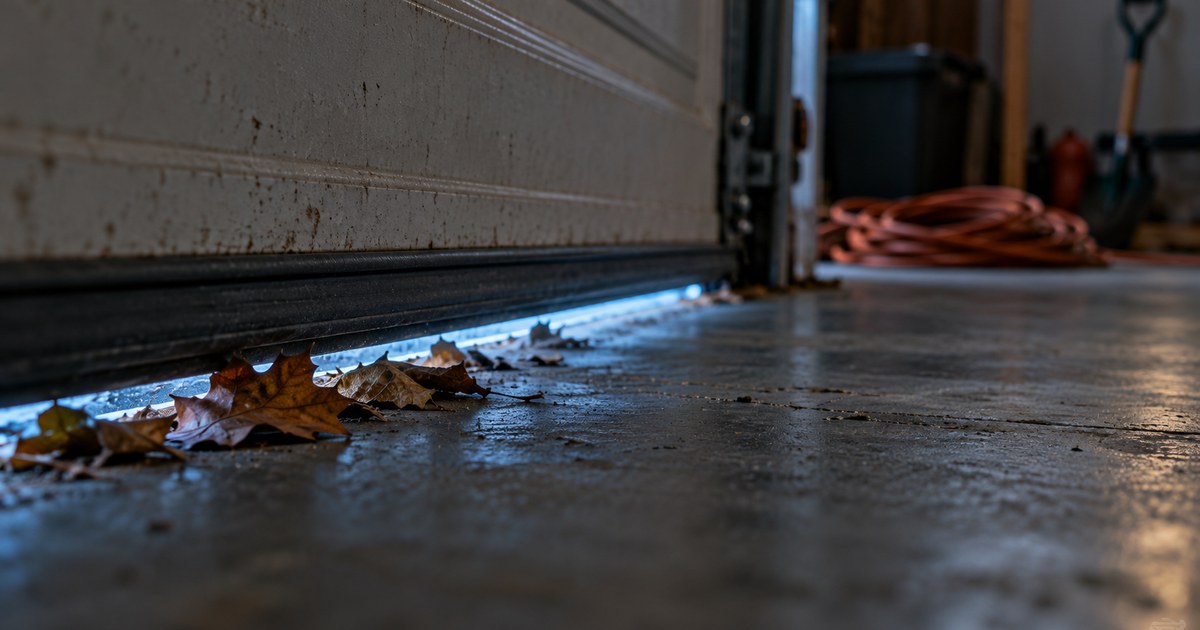
Kentucky describes ground beetles occasionally wandering into homes by crawling through small openings or under doors, and is direct about the sequel: they will not stay indoors, as they prefer the outdoors where prey is more common. Iowa State says they usually gain entrance by crawling in through small cracks or openings, or through open doorways and windows, and that they feed mostly at night and may be attracted to lights. Kentucky adds that most species do not use their wings, though a few may fly to lights at night, which is how one ends up at a lit doorway in the first place.
A beetle that behaves this way is what Iowa State calls a household accidental invader: an insect that comes in from the surrounding landscape rather than one that lives in the building. Iowa State’s definition of that category is worth quoting rather than paraphrasing. Accidental invaders cannot reproduce indoors. They do not feed on people, pets, houseplants, stored products or furnishings. Iowa State’s own ground beetle entry lines up with it, noting that they do not damage household structures or furniture.
What follows from that is the useful part. There is nothing for a predator to hunt on a concrete floor, so what you have is one insect having a bad night, not a population. Anything beyond the name, including a recurring stream of beetles through one particular gap, belongs to your local university extension service or a licensed professional.
Getting a picture that is worth anything
The hard part with this one is speed, not size. A ground beetle in the open will not wait, so the frame you get is usually the one after it stops, against a baseboard or under the edge of something.
Shoot from directly above, because all three of the features that matter, the grooves, the seam and the narrow head in front of a wider thorax, are top-down. Put a coin or a ruled edge in the frame. Do not move the beetle. If it has stopped somewhere dark, light it from the side you are standing on rather than from behind, since a backlit black beetle photographs as a silhouette and a silhouette has no grooves in it.
That photograph will give you the family, which is the answer that changes what a household does next. It will not give you a species. With approximately 2,440 North American species in the family, species-level work is done under a scope, and a county extension office is where to take it if the answer has to be exact.
From a single frame, Bug Identifier will name the beetle and tell you its role, meaning whether it is beneficial, harmless or a pest and to what, which in this case is the whole question. It gives the common name, the other names it goes by, the scientific name and classification, and a description of the appearance to check the match against. Scans are kept by date, so a yard slowly becomes a record rather than a series of unconnected surprises.
To start from the room and the description instead of from a name, go to what bug is this.
Sources
- ENTFACT-706: Ground Beetles, University of Kentucky Entomology
- Ground and Tiger Beetles (Coleoptera: Carabidae), Penn State Extension
- Ground Beetles: Predators That Provide Benefits in Agricultural Landscapes, SDSU Extension
- Ground Beetle, Iowa State University Yard and Garden
- Household Accidental Invaders, Iowa State University Yard and Garden